If you have been wondering when is a cat considered a senior, the short answer from most vets is around age 10. But the full picture is a bit more layered than that, and knowing the details matters more than you might think. Cats can look perfectly healthy at 10, 11, or even 12 years old while quietly developing conditions that are much easier to treat when caught early.
This guide covers exactly what the current veterinary guidelines say, how the life stages break down, which health conditions appear in senior cats, and what you should be doing differently – at the vet and at home – once your cat reaches that threshold.
What Age Is a Cat Considered Senior? The Official Vet Answer
The two organisations that set the clinical standard for cat care globally are the American Association of Feline Practitioners (AAFP) and the American Animal Hospital Association (AAHA). In March 2021, they jointly published updated Feline Life Stage Guidelines, overhauling a framework that had been unchanged since 2010.
Under the updated guidelines, a cat is considered senior from approximately age 10. That same year, the AAFP published a separate, dedicated document, the 2021 AAFP Feline Senior Care Guidelines, published in the Journal of Feline Medicine and Surgery, which also focuses on cats aged 10 and older.
This is a change from older classifications that placed “senior” at age 11 to 14 and “geriatric” at 15 and above. The shift to age 10 reflects clinical evidence that cats begin experiencing internal physiological changes earlier than the old framework acknowledged.
Bottom line: If your cat just turned 10, they are now in the senior category according to the most current vet guidelines, regardless of how healthy they look.
The Complete Cat Life Stage Breakdown
Here is how the five life stages look under the 2021 AAHA/AAFP framework:
| Life Stage | Age Range | Care Priority |
|---|---|---|
| Kitten | Birth to ~6 months | Vaccines, socialisation, nutrition |
| Young Adult | 1 to 6 years | Dental hygiene, healthy weight, annual vet checks |
| Mature Adult | 7 to 10 years | Annual exams, early screening worth starting |
| Senior | 10+ years | Bi-annual vet exams, senior blood panels, diet review |
| End-of-Life | Varies | Palliative care, quality of life focus |
One thing the guidelines are clear about: these age thresholds are a starting point, not a rigid trigger. Some cats at 10 are in excellent shape and may still be managed more like a mature adult based on individual health status. Others show changes earlier. A cat-by-cat assessment at every exam is what the guidelines actually recommend.
Cat Age in Human Years: What Your Cat’s Age Really Means
The “one cat year equals seven human years” formula is scientifically inaccurate. Cats age fast early in life and then slow down considerably. You can use our cat age calculator to get the precise human-year equivalent for your cat’s actual age, but here is the general breakdown:
| Cat Age | Human Age Equivalent | Life Stage |
|---|---|---|
| 1 year | ~15 years | Junior |
| 2 years | ~24 years | Junior |
| 5 years | ~36 years | Prime |
| 8 years | ~48 years | Mature |
| 10 years | ~56 years | Senior |
| 12 years | ~64 years | Senior |
| 15 years | ~76 years | Senior/Geriatric |
| 20 years | ~96 years | Geriatric |
After the first two years, cats age at roughly four human years per calendar year. A 10-year-old cat is the biological equivalent of a person in their mid-fifties. That is the age when doctors routinely start checking blood pressure, kidney function, and thyroid levels in humans. Vets apply the exact same logic to cats.
Want to check where your cat sits right now? Try the Pet Age Calculator – it gives you your cat’s human age equivalent instantly.
Health Conditions That Arrive With Senior Cat Age
Certain health problems cluster reliably around the senior years. None of them is inevitable, but all of them are worth knowing because early detection changes outcomes dramatically.
Chronic Kidney Disease
Chronic kidney disease (CKD) is one of the most common illnesses in cats aged 10 and over. Research into cat mortality found renal disorders accounted for roughly 12 percent of deaths, making it one of the top killers in older cats. The problem is that it develops silently.
Early warning signs:
- Drinking more water than usual
- Using the litter box more frequently
- Gradual weight loss over weeks or months
- Reduced appetite
- Increased lethargy
Without routine bloodwork, CKD is almost impossible to detect in early stages. That is the main reason twice-yearly vet visits matter so much from age 10.
Hyperthyroidism
Hyperthyroidism is the most common hormonal disorder in cats, with an average onset around age 13. It is caused by an overactive thyroid gland and is almost exclusively found in cats aged 10 and older.
Signs to watch for:
- Weight loss, even though the cat is eating well
- Restlessness or unusual hyperactivity
- Vomiting or loose stools
- Increased vocalisation
- Dull or matted coat
Thyroid levels are now part of routine senior wellness panels because the condition is so prevalent in this age group.
Dental Disease
Most cats already have some degree of dental disease by middle age, and it worsens through the senior years. The 2021 AAFP guidelines flag painful dental disease as a direct cause of reduced appetite, weight loss, and lower quality of life in senior cats. It is easy to overlook at home because cats rarely show obvious signs of mouth pain.
Feline Cognitive Dysfunction Syndrome
Comparable to dementia in humans, feline cognitive dysfunction syndrome (FCDS) affects memory, awareness, and behaviour. It becomes more common after age 15 but can appear earlier and is frequently dismissed as “just getting old.”
Signs include:
- Confusion in familiar spaces
- Disrupted sleep cycles
- Increased night-time howling or vocalisation
- Reduced interest in social interaction
- Litter box accidents
Joint Disease
A study in the Journal of Feline Medicine and Surgery found that over 90 percent of cats over age 12 showed radiographic evidence of degenerative joint changes. Many of those cats showed no obvious limp. The changes were quiet, but real.
What Your Vet Should Be Doing From Senior Cat Age 10
The AAHA formally recommends health exams every six months for senior cats. AAHA Chief Medical Officer Heather Loenser, DVM, confirmed this at the release of the 2021 guidelines: all cats need thorough physical examinations at least annually, with six-month checkups as the standard for seniors.
A proper senior wellness exam goes beyond listening to the heart and checking weight. Here is what it should include:
| Test | What It Screens For |
|---|---|
| Full Blood Count | Anaemia, immune function, infection |
| Chemistry Panel | Kidney and liver function |
| Thyroid Level (T4) | Hyperthyroidism screening |
| Urinalysis | Kidney disease, diabetes, infection markers |
| Blood Pressure | Hypertension linked to kidney and thyroid issues |
| Body Weight Tracking | Compared against previous visits for trends |
| Dental Assessment | Periodontal disease, oral tumours |
These tests build a baseline your vet can track over time. A single reading means little. A pattern across three or four visits tells the real story.
If your vet has not yet brought up twice-yearly visits or a senior panel, bring it up yourself at the next appointment. It does not happen automatically everywhere, and it is worth asking for.
Senior Cat Care at Home: What to Change Right Now
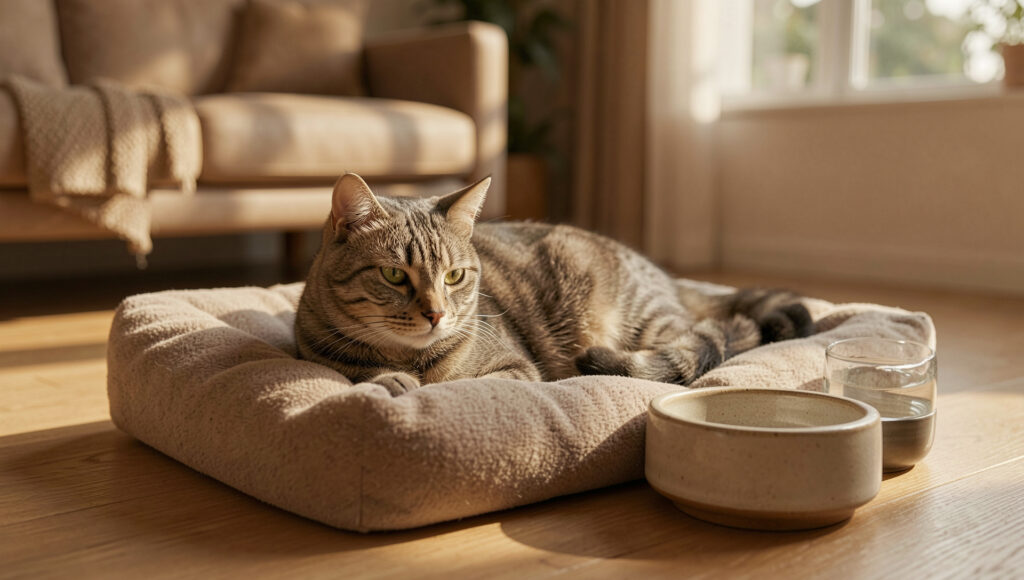
You do not need to overhaul your home. A few targeted adjustments make a real difference to a senior cat’s daily comfort and long-term health.
Litter Box
- Use a box with low sides – reduces the step-over height for cats with joint stiffness
- Place a box on every floor of the home – removes the need to climb stairs to go
- Keep the box in a fixed, quiet spot – disoriented cats rely on routine
Food and Nutrition
- Switch to a senior-formulated cat food – designed to support kidney health and lean muscle
- Studies confirm fat and protein digestibility decreases with age in cats, so high-quality ingredients matter more now
- Energy requirements can actually increase after age 12, so do not cut portions automatically
- Add or increase wet food – boosts hydration and is easier to eat for cats with dental discomfort
- Use raised bowls – reduces strain on the neck and shoulders
To understand your cat’s life stage and adjust their nutrition correctly, check the full cat age in human years breakdown at our Cat Age Calculator – it shows exactly where your cat sits developmentally.
Weight Monitoring
- Weigh your cat once a month using a digital scale
- Always weigh at the same time of day
- A small but consistent drop over two or three months is worth flagging
Research shows senior cats are the life stage most likely to be underweight, not overweight. Both kidney disease and hyperthyroidism cause weight loss before other symptoms show up. Regular home weigh-ins are one of the cheapest and most useful tools available.
Environment
- Provide low or ramp-accessible beds to reduce jumping effort on stiff joints
- Keep a consistent daily routine for feeding and play – helps cats showing early cognitive changes
- Maintain a warm home temperature – older cats are more vulnerable to cold
- Reduce stressors where possible – avoid frequent furniture rearranging, new pets introduced without transition, or loud disruption
When to Call the Vet Between Scheduled Appointments
Do not wait for the six-month check if any of these appear:
- Sudden weight loss over two to four weeks
- Refusing food for more than 24 hours
- Dramatically increased or decreased water intake
- Straining to use the litter box or having accidents outside it
- Visible pain or stiffness when moving or being touched
- New or persistent night-time vocalisation
- Confusion, disorientation, or staring blankly at walls
These are not quirks of old age. They are clinical signs that warrant a prompt vet visit, not a watch-and-wait approach.
The Takeaway
A cat is considered senior from around age 10, based on the most current AAFP and AAHA guidelines. That is earlier than many owners expect. The conditions that most commonly affect senior cats – kidney disease, hyperthyroidism, dental disease, joint stiffness, and cognitive changes – are all far more manageable when caught before they become advanced.
Twice-yearly vet visits, a senior blood panel, monthly home weight checks, and a few simple home adjustments are the building blocks of good senior cat care. None of it is complicated. It just requires knowing the threshold has been reached and responding to it.
Not sure exactly how old your cat is in human terms? Run their age through our free cat age calculator and see exactly where they are in their life journey – so you can plan their care accordingly.
FAQs
According to the 2021 AAHA/AAFP Feline Life Stage Guidelines, a cat is considered senior from approximately age 10. Older frameworks placed this at age 11, but current clinical guidance has shifted the threshold earlier.
Not under the current guidelines. A 7-year-old cat falls into the mature adult category (ages 7 to 10). Senior status begins at around age 10. That said, bi-annual vet screening is worth discussing from age 7 onwards.
A 10-year-old cat is approximately equivalent to a 56-year-old human. Use the cat age calculator for a precise conversion based on your cat’s exact age.
Common early signs include drinking more water, sleeping more, slower movement, weight loss, and reduced interest in play. Many senior cats show no obvious symptoms, which is why routine blood panels from age 10 are so important.
The AAHA recommends that cats aged 10 and older. Annual visits are no longer enough at this stage because conditions like kidney disease and hyperthyroidism can progress quickly between appointments.
The senior threshold applies to both, but indoor cats generally live considerably longer. An indoor cat reaching senior age at 10 is likely to have more healthy years ahead of them than an outdoor cat of the same age.