
A few months ago, my neighbour Priya adopted a cream-coloured cat she found wandering near her apartment building. The cat was calm, well-groomed, and clearly not feral – someone had loved her before. Priya named her Biscuit and drove straight to the vet.
The first thing Dr. Mehta did was open Biscuit’s mouth. He looked for about twenty seconds, nodded, and said: “She’s probably 4 to 5 years old. Not young, not senior. Right in the middle.”
Priya had guessed she was about 2 years old. Biscuit’s soft coat and bright green eyes had thrown her completely off.
“Teeth don’t lie,” Dr. Mehta told her with a smile.
That visit stayed with me. Most cat owners never think to check a cat’s teeth when guessing their age – they look at the fur, the eyes, the energy level. But for vets, the teeth are the first and most reliable stop. Whether you’ve adopted a rescue cat, found a stray, or you’re simply curious about your own cat’s true age, this complete cat teeth age chart breaks down everything you need to know – from newborn to senior, stage by stage.
Why Vets Use Teeth to Estimate Cat Age
Teeth are the most information-dense age marker on a cat’s body, particularly during the first year of life. The reason is simple: cats go through a completely predictable dental timeline.
- Kittens develop two full sets of teeth – 26 baby teeth followed by 30 permanent adult teeth – on a schedule precise enough to estimate age within weeks
- Adult teeth change in appearance over time – whiteness fades, tartar accumulates, and surfaces wear down in patterns that correspond to age ranges
- The tooth check is fast, non-invasive, and requires no equipment, which is why it is the first thing most vets do with a cat of unknown age
There are limits, of course. A cat that has received professional dental cleanings regularly may have teeth that look considerably younger than the cat actually is. Genetics and diet also influence how fast a cat’s teeth age. This is why vets always combine the teeth check with other signs – the eyes, muscle tone, coat quality, and the cat’s behavior. But as a starting point? Teeth are unbeatable.
Once you know your cat’s approximate age, you can see exactly what life stage they’re in. Use our free cat age calculator to convert their age into human years.
The Complete Cat Teeth Age Chart at a Glance
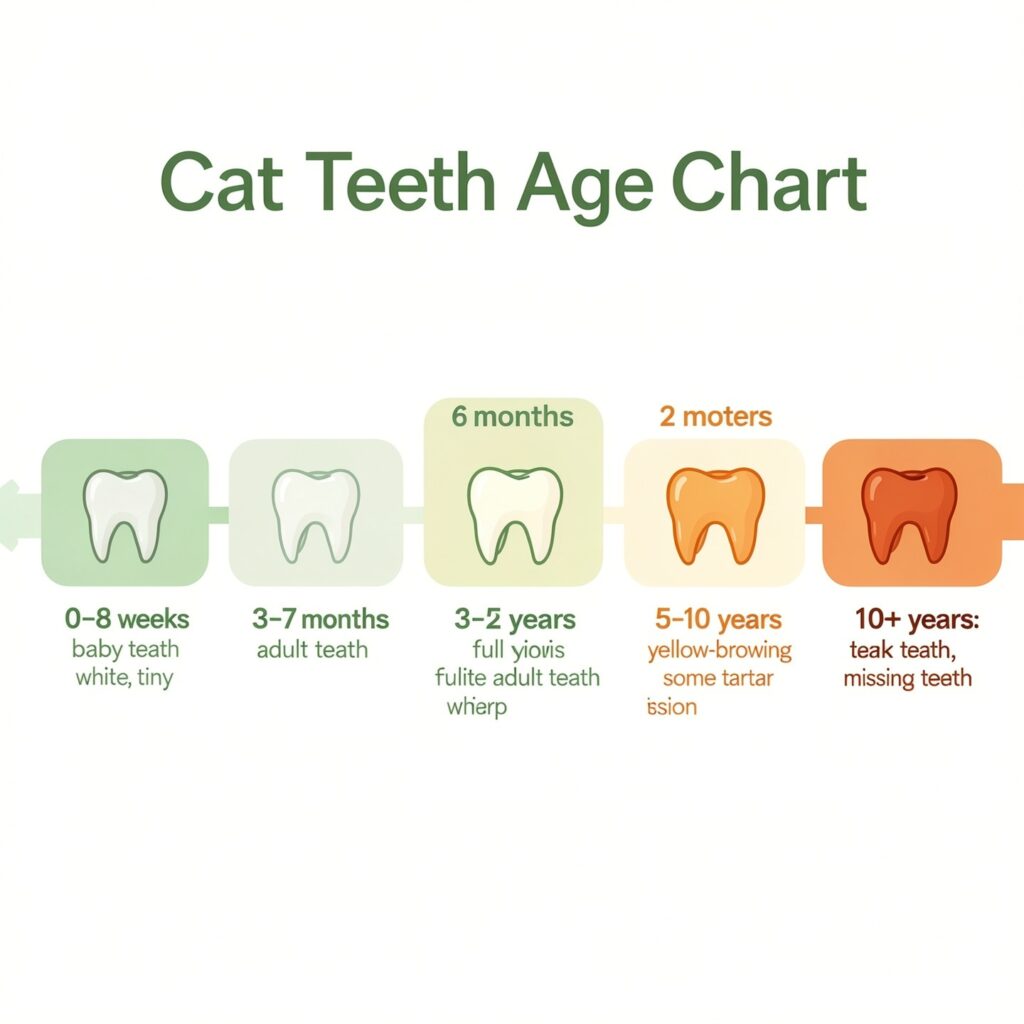
| Cat’s Age | Teeth Present | Colour | Tartar | What to Look For |
| 0 – 2 weeks | None | – | None | Completely toothless at birth |
| 2 – 4 weeks | Baby incisors emerging | White | None | First tiny teeth at the gum line |
| 4 – 6 weeks | Baby canines and premolars | White | None | More than 14 baby teeth are visible |
| 6 – 8 weeks | Full baby set (26 teeth) | White | None | All deciduous teeth present |
| 3 – 4 months | Mixed: some baby, some adult | White | None | Adult incisors pushing through |
| 4 – 7 months | Baby teeth falling out | White | None | Gaps in the mouth, tooth transition |
| 6 months – 2 years | Full adult set (30 teeth) | Bright white | None to minimal | Sharp tips, clean pink gums |
| 2 – 3 years | Full adult set | Faint yellowing starting | Very light | Slight staining on the back molars |
| 3 – 5 years | Full adult set | Moderate yellowing | Noticeable | Tartar on multiple teeth |
| 5 – 7 years | Full adult set | Yellow to light brown | Heavy | Worn tips, early gum recession |
| 7 – 10 years | May have missing teeth | Dark yellow or brown | Heavy | Gum disease common |
| 10+ years | Often 1 or more teeth are missing | Brown or darkened | Very heavy | Significant wear and tooth loss |
Kitten Teeth: Birth to 6 Months
If you’re trying to estimate the age of a very young cat, the teeth tell an almost exact story. The timing of kitten dental development is highly predictable, and vets can narrow down a kitten’s age to within days or weeks simply by checking what’s in the mouth.
1. Birth to 2 Weeks: No Teeth
Kittens enter the world completely toothless. This makes biological sense – newborns drink only their mother’s milk, and teeth would serve no purpose in those first weeks.
What else will you see at this stage:
- Eyes are sealed shut (they open between 7 and 10 days)
- Ears are folded flat against the head
- The kitten cannot walk, only wriggle
- Totally dependent on the mother for warmth and feeding
2. 2 to 4 Weeks: First Baby Incisors Appear
The first teeth to emerge are the deciduous incisors – the tiny front teeth. They start pressing through the gums around 2 to 3 weeks of age. Small, sharp, and white, these are the first reliable signs that a kitten is past the newborn stage.
What you’ll see:
- 4 to 6 small white teeth at the very front of the mouth
- Eyes beginning to open, still adjusting to light
- Kitten starting its wobbly first steps
- Still nursing, but may show curiosity about solid smells
3. 4 to 6 Weeks: Canines and Premolars Come In
The baby canine teeth (the pointed fangs) emerge around 3 to 4 weeks. The deciduous premolars follow along the sides of the jaw between 4 and 6 weeks.
By 5 to 6 weeks, a kitten’s mouth looks like a tiny row of white needles. Every tooth is delicate, pointed, and perfectly white.
What you’ll see:
- 14 to 20 baby teeth fully visible
- Kitten starting to eat soft solid food alongside nursing
- Eyes fully open and beginning to shift from blue to permanent colour
- Much more mobile and playful
4. 6 to 8 Weeks: Full Set of Baby Teeth – 26 Total
By 6 to 8 weeks, kittens have their complete deciduous set of 26 teeth:
- 12 incisors – 6 on top, 6 on bottom
- 4 canines – 2 on top, 2 on bottom
- 10 premolars – 6 on top, 4 on bottom
Note that kittens do not have baby molars – those teeth only appear in the adult permanent set. If you see a full mouthful of tiny, perfect white teeth with no gaps, you’re almost certainly looking at a 6- to 8-week-old kitten.
5. 3 to 4 Months: Adult Teeth Begin to Erupt
This is where the mouth becomes a real clue. Around 3 to 4 months, the permanent adult teeth start pushing through the gums, and the baby teeth begin to loosen and fall out. This stage is called the period of mixed dentition, and it looks exactly how it sounds.
The order of permanent teeth erupts:
- Incisors: 3 to 4 months
- Canines: 4 to 5 months
- Premolars: 4 to 6 months
- Molars: 4 to 5 months
If you see gaps in the mouth, wobbling baby teeth, or both small and large teeth side by side in the same row, you’re looking at a 3- to 5-month-old cat.
6. 4 to 7 Months: Complete Adult Set – 30 Permanent Teeth
By 6 to 7 months, the permanent adult set is complete. A cat’s 30 permanent teeth consist of:
- 12 incisors (6 top, 6 bottom)
- 4 canines (2 top, 2 bottom)
- 10 premolars (6 top, 4 bottom)
- 4 molars (1 on each back corner, top and bottom)
At this stage, the permanent teeth are brilliant white, sharp at the tips, and show zero signs of wear. The canine teeth, in particular, look prominent and pointed. If a cat has a full set of 30 gleaming white adult teeth and zero tartar, they are almost certainly 6 months to 1 year old.
Young Adult Cat Teeth: 6 Months to 2 Years
Once the full adult set is in place, the teeth of a cat between 6 months and 2 years look nearly identical – making it hard to tell a 10-month-old from an 18-month-old by teeth alone.
Characteristics of this stage:
- Bright, pure white – no yellowing at all, or at most a barely visible hint on one or two back teeth by 18 months
- Sharp tips on all teeth, especially the incisors and canines
- No visible tartar or plaque buildup
- Gums are pink, firm, and tight-fitting, snugly around each tooth base
- No missing teeth, no chips, no wear marks
Some cats begin showing a faint tinge of yellow on the back molars at 18 months to 2 years. It is subtle enough that you may not notice it without tilting the cat’s head toward a good light source.
Adult Cat Teeth: 2 to 5 Years
This is the window where the teeth begin to tell a much more specific story.
1. Ages 2 to 3: Early Yellowing and the First Tartar
The first visible changes appear around the 2-year mark. Faint yellow staining starts on the back teeth, and a thin line of tartar may be visible where the teeth meet the gum on the molars.
What to look for:
- Light yellow tint on the back premolars and molars
- The tips of the teeth are slightly less sharp than at 6 months – very subtle blunting
- Gums are still pink and healthy with no recession
- No missing teeth
2. Ages 3 to 5: Moderate Tartar, Yellowing Spreads
By 3 to 5 years, tartar buildup is noticeable on multiple teeth, and the yellowing has spread beyond just the back teeth. This is also the age window where dental disease becomes increasingly common.
According to the Cornell Feline Health Center, an estimated 50 to 90% of cats over 4 years old show some degree of dental disease. That is not a small number – it means dental care from 3 years onwards is not optional, it is expected.
What to look for:
- Moderate yellow-to-light-brown discolouration across several teeth
- Visible hard tartar deposits at the gum line, especially on the upper premolars
- Possible mild gum redness (early gingivitis)
- Tooth tips show wear – the points are less razor-sharp than before
Mature Cat Teeth: 5 to 10 Years
1. Ages 5 to 7: Heavy Tartar and Worn Surfaces
At 5 to 7 years, the tartar is typically obvious even to an untrained eye. Wear on the tooth surfaces is visible.
What to look for:
- Dark yellow or brown coloration across most teeth
- Heavy tartar along and beneath the gum line
- Gum recession is becoming visible – the gum line may look lower than normal
- Tooth tips are noticeably blunted – no longer pointed
- Possibly one missing tooth
2. Ages 7 to 10: Dental Disease Becomes the Norm
By 7 to 10 years, dental disease is widespread in cats that have not received professional cleaning or home dental care. Many cats in this range have already had at least one veterinary dental procedure.
What to look for:
- Heavy tartar on nearly every tooth
- Clear gum recession on multiple teeth
- One or more missing teeth
- Tooth resorption may be visible – the tooth appears to be dissolving at the base
- Strong bad breath (halitosis) that is difficult to ignore
Senior Cat Teeth: 10 Years and Older
A cat past 10 years old will almost always show significant dental changes – unless they have received exceptional care throughout their life.
Typical signs in senior cat teeth:
- Dark yellow or brown coloration throughout the mouth
- One or more visibly missing teeth – not just loose, but actually absent
- Gum recession across most of the mouth
- Possible oral inflammation (stomatitis), making the gums look red and swollen
- The cat may avoid hard food, drop kibble while eating, or prefer soft food entirely
- Very bad breath
It is worth noting that a well-cared-for 12-year-old cat can have teeth that look like a 7-year-old’s. This is exactly why vets never rely on teeth alone for senior cats – they check the eyes for lenticular sclerosis (normal lens cloudiness that develops around age 6 to 7), muscle wasting in the shoulders and spine, coat quality, and behaviour.
If your senior cat is showing any signs of dental pain, do not wait for the next annual checkup. Dental disease in older cats causes real, constant discomfort – and cats are masters at hiding it.
How to Check Your Cat’s Teeth at Home
You do not need a vet’s hands to do a basic dental check. Here’s how to do it safely and without stressing your cat:
Step 1 – Choose the right moment. After a meal or a play session, when your cat is relaxed. Never attempt a mouth check when they are restless or agitated.
Step 2 – Get into position. Sit your cat in your lap or on a firm surface. Support their body gently from behind with one hand.
Step 3 – Lift the upper lip. Using the thumb of your free hand, gently press upward on one side of the upper lip to expose the teeth and gums. Do not try to open the jaw – just look at the outer surfaces.
Step 4 – Look for these four things:
- Colour – white (young), yellowing (middle-aged), brown (older)
- Tartar – hard brownish deposits at the base of the tooth near the gum
- Gum health – should be pink and tight, not red, swollen, or receding
- Missing or broken teeth – gaps where a tooth should be
Step 5 – Repeat on the other side. Check both the upper and lower teeth on both sides of the mouth.
If your cat resists or seems uncomfortable, stop. Some cats – especially those already experiencing dental pain – react strongly to mouth handling. A vet check is safer in those cases.
How to Keep Your Cat’s Teeth Healthy at Every Age
1. Brush Their Teeth Regularly
Daily brushing with cat-safe toothpaste is the single most effective thing you can do. Even brushing 2 to 3 times per week significantly reduces plaque before it hardens into tartar. Important: never use human toothpaste. It contains fluoride and xylitol, both toxic to cats. Choose a flavour your cat will tolerate – chicken or seafood-flavoured options work well.
2. Schedule Annual Professional Cleanings
The American Animal Hospital Association recommends that cats have their first full dental evaluation by age 1, and then annually. Professional cleanings under anaesthesia are the only way to remove hardened tartar and clean beneath the gum line. Home brushing cannot do this.
3. Feed a Dental-Appropriate Diet
Certain dry foods are designed with larger, fibrous kibble that has a mild scrubbing effect as the cat chews. Ask your vet about VOHC-certified (Veterinary Oral Health Council) dental diets and treats – these are the only products with independently verified evidence for reducing plaque and tartar.
4. Use Dental Water Additives or Wipes
For cats that absolutely refuse brushing, dental water additives (added to the water bowl) and dental wipes offer a secondary option. They are not as effective as brushing, but are far better than doing nothing.
5. Watch for Warning Signs and Act Quickly
Take your cat to the vet promptly if you notice the following:
- Unusually strong or foul-smelling breath
- Excessive drooling
- Pawing repeatedly at the mouth or face
- Dropping food while eating, or chewing only on one side
- Swollen, bleeding, or very red gums
- Reluctance to eat or sudden preference for soft food only
- Weight loss alongside these signs
Dental disease causes real pain in cats. Because cats are instinctively good at hiding discomfort, the outward signs often only appear once the problem is already advanced. Annual vet visits make a genuine difference in catching problems early.
FAQs
Not exactly – teeth give an estimate, not a precise birthday. For kittens under 6 months, the estimate can be accurate within weeks, since the dental timeline at that age is very predictable. For adult and senior cats, teeth give you an age range, usually within 2 to 3 years. A vet will combine the teeth check with other signs (eyes, coat, muscle tone, behaviour) to narrow it down further.
Early tartar in younger cats usually reflects a lack of dental care, poor diet, or genetics – not actual aging. A 3-year-old that has never had a professional cleaning and eats a soft-food-only diet can have the teeth of a 7-year-old. Teeth are a guide, not a perfect clock.
Yes, especially past age 10. The most common causes are advanced periodontal disease, where the structures holding the tooth in place break down, and tooth resorption, where the tooth’s own structure dissolves from within. Both conditions are painful and often require professional treatment, including the extraction of the affected tooth. If your cat loses a tooth, have your vet check the site for retained roots or infection.
Baby teeth are noticeably smaller, thinner, and more delicate-looking than adult teeth. The canine teeth are the clearest comparison – a baby canine is tiny compared to the prominent adult fang that replaces it. If you spot what looks like two canines on the same side (one small and one large, side by side), that is a retained baby tooth that hasn’t fallen out on schedule. This needs veterinary attention, as retained teeth can cause crowding and bite problems.
Yes. Chronic dental disease is painful, causes difficulty eating, and if left untreated, allows bacteria to enter the bloodstream – potentially affecting the heart, kidneys, and liver. Cats with good dental health eat better, maintain weight more easily, and live more comfortably in their senior years. Dental care is genuinely one of the highest-impact things an owner can do for a cat’s long-term health.